
Mrazivý únor 1956 v Česku a ve střední Evropě
Pavel Lipina1, Veronika Šustková1, Jan Procházka2, Miloslav Müller3,4 Klára Čížková1
1 Český hydrometeorologický ústav, pobočka Ostrava, K Myslivně 3/2185, 708 00 Ostrava-Poruba, pavel.lipina@chmi.cz, veronika.sustkova@chmi.cz, klara.cizkova@chmi.cz
2 Jihočeská univerzita v Českých Budějovicích, Fakulta zemědělská a technologická, Studentská 1668, 37005 České Budějovice, prochazkaj@fzt.jcu.cz
3 Ústav fyziky atmosféry AV ČR, v. v. i., oddělení meteorologie, Boční II 1401, 141 00 Praha 4, muller@ufa.cas.cz 4 Univerzita Karlova, Přírodovědecká fakulta, katedra fyzické geografie a geoekologie, Albertov 6, 120 00 Praha 2
1. Úvod
V únoru 2026 uplynulo 70 let od extrémně studeného února 1956. Tento měsíc je často srovnáván s únorem 1929, který byl v Česku nejchladnějším měsícem v posledních 150 letech, kdy máme dostupná měřená data potřebná k takovému vyhodnocení. Denní minima teploty vzduchu zaznamenaná 31. ledna a ve dnech 1., 9. a 10. února (na Slovensku také 16.–18. února) 1956 se často srovnávají s českým absolutním minimem z 11. února 1929.
Na základě vyprávění pamětníků ze Šumavy se objevují informace, že se v únoru 1956 mohly v mrazových oblastech vyskytnout teploty vzduchu až kolem −45 °C. Z tohoto důvodu jsme se na počátku domnívali, že podrobně zpracujeme celou zimu 1955/1956. Při analýze nejchladnějších zim jsme však zjistili, že zima 1955/1956 jako celek nepatří mezi ty nechladnější, proto jsme od podrobného zpracování celé zimy upustili. Soustředili jsme se zejména na příčiny a průběh nejchladnějšího období, tj. přibližně od 31. ledna do 10. února 1956, a následně na podrobnější zhodnocení února 1956 jako celku.
Protože rozloha Česka není příliš velká a počasí a podnebí obvykle „nerespektují“ státní hranice, rozhodli jsme se zpracovat tuto epizodu na širším území, tj. včetně okolních zemí. Do zpracování jsme zahrnuli všechna dostupná data z Česka, Slovenska, Polska, Německa a Rakouska. Věříme, že regionálně rozšířený přístup přinese čtenářům zajímavé informace nejen o extrémech teploty vzduchu, ale také o dostupnosti meteorologických dat v tomto období na daném území.
V průběhu zpracování této mimořádně chladné epizody jsme nashromáždili velké množství zajímavých dat, datových souborů, grafů a map. Rozhodli jsme se proto zpřístupnit i materiály, které se do příspěvku nevešly, prostřednictvím webové stránky vytvořené k tomuto článku.
2. Zima 1955/1956 v literatuře a v médiích
Michal Žák s Tomášem Karlíkem (2026) uvedli na webu ČT24: „Únor před sedmdesáti lety přinesl výjimečně chladné teploty. Tehdy sevřel sibiřský mráz většinu Evropy, včetně tuzemska. Chlad, který přišel z ruské části Arktidy, způsobil kontinentu spoustu problémů.“
V minulosti se vyskytly zimy ještě studenější. Ta nejchladnější nastala už v sezoně 1829/1830 s průměrnou teplotou vzduchu v Praze-Klementinu −6,2 °C. Proslulá zima 1928/1929, během které byla zaznamenána dosud nejnižší teplota vzduchu na českém území (−42,2 °C v Litvínovicích u Českých Budějovic), se v klementinské řadě umístila až na šestém místě. Nicméně právě únor 1929 se stal vůbec nejchladnějším měsícem z celé klementinské řady od roku 1775, jeho průměrná teplota tehdy dosáhla −11,0 °C. Po prosinci 1788 s průměrnou teplotou vzduchu −9,7 °C se na třetím místě umístil únor 1956, kdy průměrná měsíční teplota dosáhla v Klementinu hodnoty −9,4 °C (Daňhelka et al. 2025). Od té doby se v Klementinu vyskytly jen dva měsíce s průměrnou teplotou pod −5,0 °C (ledny 1963 a 1987). Pro srovnání – průměrná únorová teplota za třicetiletí 1991–2020 je v Klementinu 2,3 °C.
První informací o průběhu zimy 1955–1956 v Meteorologických zprávách byl příspěvek Promrzání půd v zimě 1955–1956 (Hrbek a Krhounek 1957). Autoři se v článku zabývají různými vlivy působícími na promrzání půd a podrobně zpracovávají vliv sněhové pokrývky. V článku byla věnována pozornost průběhu teploty vzduchu, teploty půdy a výšky celkové sněhové pokrývky. V další části zpracovali autoři průběh některých meteorologických prvků ve velmi tuhých zimách 1928/29, 1953/54 a 1955/56. Z chodu teploty vzduchu je vidět, že nejdrsnější byla z hlediska teploty půdy zima 1928/29, kdy vlivem dlouhotrvajících mrazů promrzal půdní profil nejhlouběji. Promrznutí půd v zimě 1955/56 bylo menší než v zimním období 1953/54, přestože tehdy bylo tepleji, ležela totiž jen nízká sněhová pokrývka.
Ve třetím čísle Meteorologických zpráv roku 1957 vyšel stručný článek Jaroslava Maňáka s názvem Možno plánovat abnormální chod teploty v únoru? (Maňák 1957). Autor uvádí, že únorová zima 1956 překvapila kdekoho, nejvíce uživatele parovodů, kteří byli překvapeni účty za nadměrnou dodávku páry k topení v měsíci únoru. V článku autor sestavil diagram pro tzv. topné období od září do května. Tabulka teplotní zvláštnosti měsíce února od roku 1771 do roku 1956 byla určena národním podnikům, které jistě zajímalo, jak často mohou nastat obdobné abnormální poměry, aby mohly plánovat zajištění spotřeby uhlí jak pro otop, tak i pro dopravu. Z tabulky v příspěvku je patrné, že průměrně třikrát za 10 let byl únor studenější než leden.
Vpád studeného vzduchu do Evropy v zimě 1956 byl extrémní nejen hodnotami teploty vzduchu, ale i prostorovým rozsahem celé epizody. Sibiřská zima roku 1956 totiž zasáhla většinu Evropy, zejména oblasti sahající od východní Evropy přes Československo a Německo až po Francii. Například v Německu klesla průměrná teplota vzduchu v únoru 1956 na hodnotu −9,6 °C, což je o 11,1 °C méně než dlouhodobý průměr z let 1991–2020 (Deutscher Wetterdienst 2026). Nejchladněji bylo v oblasti Alp, kde bylo na italsko-švýcarské hranici naměřeno až −42,7 °C (Dizerens et al. 2017), také v Rakousku klesla minima teploty vzduchu místy pod −32,0 °C (Hanselmayer, Winter 1957).
Velké řeky, včetně Dunaje a Rýna, zamrzly. V bratislavské části Dunaje dosahovala tloušťka ledu údajně až 1,8 m. Když se led v březnu přesunul z Rakouska do Bratislavy, silná vrstva nahromaděných ledových ker zabránila odtoku vody a hladina řeky začala stoupat. Poté, co hladina Dunaje v Petržalce 3. března 1956 dosáhla výšky 912 centimetrů, začalo letecké bombardování ledové bariéry. Důvodem byly obavy, že by obrovské kusy ledu mohly poškodit pilíře Starého mostu v Bratislavě (Tvnoviny 2026). Z podobných důvodů došlo k odstřelu ledu i v Budapešti (PestBuda 2021).
Mimo střední Evropu byly nízké teploty vzduchu naměřeny například ve Švédsku, kde bylo pod −40 °C, a Moskva zažila arktických −45 °C (Andrews 1956). Ve Středomoří byl teplotně průměrný leden vystřídán mrazivým únorem, kdy 15. února 1956 v okolí francouzského Lyonu poklesla denní minima teploty vzduchu i pod −20 °C (Coquillat 1958). Ve Španělsku plnily zprávy o zamrzlých fontánách přední stránky novin (Núñez et al. 2007). Sníh zasypal Itálii, Sicílii a další středomořské ostrovy (D’Errico et al. 2022). Studený vzduch přetekl i do severní Afriky, kde bylo sněžení pozorováno například v Tunisu a v Alžíru (Andrews 1956; ItalyHeritage 2025).
Rozsáhlý nedostatek paliva a rekordně nízké teploty vyvolaly humanitární krizi, která vedla k vysokému počtu úmrtí na podchlazení po celém kontinentu (např. Coquillat 1958; Dizerens et al. 2017). Značné byly i negativní dopady na zemědělství a ekosystémy. Například v Lyonu byly zasaženy fíkovníky, platany se zlámaly mrazem, slavné vinice v Beaujoulais byly zničeny ze 40–80 %. Stovky kachen zamířily do městských parků ve snaze najít potravu a volnou vodní hladinu, spekulovalo se taktéž o možném úhynu hmyzu (Coquillat 1958). Ve Středomoří byly poškozeny i miliony olivovníků, z nichž některé byly staré až tisíc let. Téměř poeticky to popisuje Slocombe (2021): „Každý ze starších olivovníků zde na Azurovém pobřeží je zjizvený mimořádně tuhou noční mrazivou nocí 10. února 1956, kdy po denním maximu +21 °C prudký pád teplot vytlačil životodárné světlo z olivových hájů po celé Středomořské pánvi, zde v Provence, ve Španělsku a Portugalsku a myslím, že na východě až po Chorvatsko a Černou Horu. V jednom prudkém náporu teploty klesly z +21 °C ve dne na zničujících −17 °C v noci. Jednak to byla zničující denní amplituda (38 °C) ve srovnání s průměrnou amplitudou 21 °C, a zadruhé pokles na −17 °C pod bod mrazu a pokles 7 °C pod dříve stanovenou kritickou hranici pro olivy. Všechny ty jizvy byly způsobeny explozí cévních tkání ráno 11. února 1956, které navždy zničily dlouhé vertikální a lokalizované toky kambia. Romantická francouzská legenda vypráví, že den po této velké noci strašlivých mrazů, cituji doslovně, „…zvuk křiku olivovníků prostupoval sady, když míza explodovala a stromy praskaly…“.
Obrovský prostorový rozsah chladné epizody z února 1956 dokumentuje i studie Twardosz et al. (1956), která hodnotila průměrné měsíční teploty vzduchu na 60 stanicích z celé Evropy v období od poloviny 20. století do roku 2010. Měsíce, v nichž se průměrná teplota vzduchu lišila od příslušného dlouhodobého průměru (1951–2010) alespoň o dvě směrodatné odchylky, byly autory označeny jako extrémně chladné (ECM, z angl. „extremely cold month“). Tyto případy jsou v Evropě poměrně časté: během 180 zimních měsíců z let 1951–2010 se vyskytlo 67 ECM, přičemž průměrný ECM pokrýval oblast se 6 stanicemi. Nejvyšší četnost byla zaznamenána v prvních dvou desetiletích (16 a 17 případů), naopak nejnižší (7) v posledním desetiletí 20. století. Pouze jeden ECM byl zaznamenán v jihozápadní Evropě, kde je za bariérou Alp a Pyrenejí advekce studených vzduchových hmot ze severu méně častá. Únor 1956 měl z tohoto hlediska největší prostorový rozsah, ECM se vyskytl na 36 z 60 stanic. Ty pokrývaly celý jih Evropy i střední část kontinentu od Atlantiku až po Ural. V Astrachani byla tehdy zaznamenána absolutně největší teplotní anomálie (−14 °C). Dalšími ECM s velkým prostorovým rozsahem, které pokrývaly alespoň jednu třetinu stanic (přes 20), byly únor 1954, leden 1963 a leden 1987. Vzhledem k probíhajícím změnám klimatu podobných případů ubývá, i když jejich intenzita zůstává v průběhu času podobná (Cadiou, Yiou 2025). Přesto je však stále méně pravděpodobné, že k extrémům takového časoprostorového měřítka bude docházet i ve 21. století (Ribes et al. 2025). Toto téma bylo prezentováno formou posteru na horské meteorologické konferenci Krkonoše 2026 a rozšířený abstrakt byl publikován ve sborníku z konference (Lipina a kol. 2026).
3. Staniční síť Česka a okolních zemí v roce 1956
Do zpracování teploty vzduchu, úhrnu srážek, výšky nového sněhu a celkové sněhové pokrývky byly zahrnuty všechny středoevropské stanice, které měly dostupná data z února 1956. Využili jsme data z klimatologické aplikace Českého hydrometeorologického ústavu (ČHMÚ) CLIDATA (CLIDATA 2026) a doplnili je daty z ročenky Povětrnostní pozorování za rok 1956 (HMÚ 1964) pro území Česka a Slovenska a z polské meteorologické ročenky za rok 1956 (IMGW 1960). Data z Německa (OPENDATA.DWD 2025) a Rakouska (OPENDATA.GeoSphere 2025) byla získána z otevřených dat meteorologických služeb těchto států.
Datový soubor měsíčních průměrů teploty vzduchu pro únor 1956 z Česka čítá 342 stanic (obr. 1). Třicet z nich mělo v době přípravy článku dostupná data pro zpracovávanou epizodu pouze v tištěné meteorologické ročence (HMÚ 1964). Jednalo se především o stanice s krátkou dobou pozorování ukončenou před rokem 1961, což pravděpodobně vysvětluje absenci jejich digitalizace. Hodnoty denních minim teploty vzduchu pro měsíc únor 1956 jsou v Česku k dispozici z 276 meteorologických stanic.

Ze Slovenska jsou dostupná měsíční data teploty vzduchu pro 124 stanic, z nichž pro 120 jsou k dispozici i denní minima teploty vzduchu. Data z 29 těchto stanic byla k dispozici přímo v klimatologické aplikaci CLIDATA. Většinou šlo o stanice v příhraničí s Českem pocházející z meteorologických ročenek.
Z Polska bylo pro zpracování zahrnuto 387 stanic. Z tohoto počtu jsou v CLIDATA dostupná data pro 110 stanic v česko-polském příhraničí, zbytek dat z února 1956 byl získán z polské meteorologické ročenky. Denní data pro únor 1956 jsou k dispozici z 343 meteorologických stanic.
Z Německa byly v otevřených datech příslušného meteorologického ústavu k dispozici pro tuto epizodu průměrné měsíční teploty vzduchu z 535 stanic. Denní minima teploty vzduchu jsou k dispozici z 520 stanic. Z Rakouska jsou pro zimu 1955/1956 k dispozici data z 207 stanic. Aplikace CLIDATA žádná data z února 1956 z Německa a Rakouska nezahrnuje.
Celkem byla pro zpracovávání zimní sezony 1955/1956 a února 1956 k dispozici pro Česko a čtyři okolní země data z 1592 meteorologických stanic. Přehled meteorologických stanic, jejich geografické informace, data, grafy, tabulky a mapy jsou k dispozici v elektronické formě na webové stránce (ČMeS 2026).
4. Průběh počasí během února
Pomyslným úvodem k mrazivému únoru 1956 byl 27. leden, kdy přímo přes Česko přešla po zvlněném frontálním rozhraní od severozápadu k jihovýchodu tlaková níže. V souvislosti s tím spadlo např. v Praze-Klementinu 8 cm sněhu, načež se zde souvislá sněhová pokrývka udržela až do konce února. 28. leden zároveň zahájil sérii 31 po sobě jdoucích ledových dní (maximální denní teplota pod 0 °C, celodenní mráz) na této stanici (obr. 2).

Zásadní roli v tak výrazné změně charakteru do té doby nadnormálně teplé zimy sehrál výškový hřeben vysokého tlaku vzduchu, který se 28. ledna rozšířil od jihu až do severní Skandinávie. V oblasti severovýchodního Atlantiku se následně po většinu měsíce udržovala mohutná anticyklona, detailně popsaná například ve studiích Andrews et al. (1956) či Dizerens et al. (2017). Zmíněnou situaci dokládají vysoké hodnoty geopotenciální výšky hladiny 500 hPa na 60. rovnoběžce západně od nultého poledníku (obr. 3 vlevo). Tlaková výše zcela zablokovala běžné západní proudění, které má v zimě pro Evropu oteplující účinky. Z tohoto důvodu převládla nad územím Česka studená kontinentální vzduchová hmota, která zde vyvolala zápornou anomálii teploty vzduchu. V hladině 850 hPa přesáhla ve dnech kolem 1. a 10. února nad Českem −15 °C (obr. 3 vpravo). Těmto zesílením chladné anomálie přesně odpovídají dvě epizody po sobě jdoucích arktických dnů v Praze-Klementinu (obr. 2).


Obr. 3 Hovmöllerovy diagramy vyjadřující průběh meteorologických prvků během zimy 1955–1956 podle reanalýzy NCEP/NCAR: vlevo geopotenciální výška hladiny 500 hPa podél 60. rovnoběžky, vpravo odchylka teploty vzduchu v hladině 850 hPa od normálu 1991–2020 podél 50. rovnoběžky. Zdroj: NOAA Physical Sciences Laboratory, Boulder Colorado, http://psl.noaa.gov/.
Nejchladnějším obdobím celé tehdejší zimy byla v Česku trojice dní 9. až 11. února 1956. K upřesnění průběhu tehdejšího počasí je vhodné využít staničních hodnot v klimatologických termínech. Denní minima a maxima teploty vzduchu se totiž určují za období od 21 h předešlého dne do 21 h místního času daného dne, takže při prudkých ochlazeních nemusí dobře vystihovat skutečný průběh teploty vzduchu (obr. 4). To se projevilo i 9. února, kdy na příkladu z pražského Klementina sledujeme netradičně velkou denní amplitudu teploty vzduchu, která by standardně naznačovala radiační typ počasí. Denní maximum však nastalo již předchozího dne večer, načež se během noci prudce ochladilo, a to v celé troposféře (obr. 5). Ráno bylo zataženo a vál severní vítr, jehož rychlost např. na Milešovce dosahovala 15 m.s-1. Nešlo tedy o typickou situaci ranních mrazů při vyjasnění a bezvětří, kdy se vytváří silná přízemní radiační inverze teploty vzduchu. Naopak s rostoucí nadmořskou výškou teplota vzduchu výrazně klesala, proto bylo mimořádně chladno především na horských stanicích (obr. 6 vlevo), z nichž mnohé naměřily svá absolutní teplotní minima. Příčinou byl přesun extrémně studené vzduchové hmoty, která se po řadu předchozích dní udržovala nad Ruskem, nad naše území (obr. 7 vlevo). Kvůli prudkému větru byla přitom na horách extrémně nízká i tzv. pocitová teplota, která např. na Milešovce klesla podle indexu Wind Chill až na −46,5 °C.


Den 9. února však byl extrémní i v nižších polohách Česka, zejména z hlediska odpoledních teplot. Např. v Klementinu dosáhla ve 14 hodin teplota vzduchu jen −20,4 °C, což je zde nejnižší hodnota v odpoledním termínu od roku 1850. Na většině území Česka tak zřejmě byla po celý den teplota vzduchu pod −20 °C. Přitom slábl vítr, postupně se vyjasňovalo a ve vyšších hladinách se mírně oteplovalo v souvislosti s přesunem nejchladnější vzduchové hmoty směrem k jihozápadu (obr. 7 vpravo). Kvůli výrazné přízemní teplotní inverzi pak bylo nejmrazivější až ráno 10. února. Extrémně nízké hodnoty teploty vzduchu byly dosaženy především v mělkých horských údolích na Šumavě (−37,5 °C v Hůrce u Horní Plané), ale i v nižších nadmořských výškách (−37,0 °C v Borkovicích poblíž Veselí nad Lužnicí; obr. 6 vpravo).
5. Měsíční minima teploty vzduchu
Leden 1956
Protože k výraznému ochlazení došlo už koncem ledna 1956, dosáhla velmi nízkých hodnot již lednová minima teploty vzduchu, která byla na 267 českých stanicích (96,7 %) zaznamenána v posledním dni tohoto měsíce (obr. 8). V Česku to bylo −30,8 °C na stanici Bedřichov, přehrada (775 m n. m.), −29,4 °C na stanici Sedlice (dříve okres Humpolec, 440 m n. m.), −29,0 °C v Dačicích (471 m n. m.) a v Poličce (552 m n. m.), −28,6 °C na Pradědu (1490 m n. m.), −27,7 °C v obci Puklice nedaleko Jihlavy (522 m n. m.), −27,6 °C v Jihlavě, vodárně (501 m n. m.), −27,5 °C na Sněžce (1 602 m n. m.) a v Karlově Studánce (779 m n. m.) a −27,2 °C v Jablonci nad Nisou (500 m n. m.).
Ještě nižší lednová minima byla dosažena 31. ledna na mnoha stanicích v okolních zemích, přičemž mnohdy šlo o nízko položené stanice: −36,4 °C na polské stanici Ostojów (v povodí řeky Niemen, 240 m n. m.), −35,0 °C na slovenské stanici Oravská Lesná (762 m n. m.), −33,9 °C na polské stanici Istebna, Zaolzie (580 m n. m.), −33,8 °C na polské stanici Bartoszyce (v povodí Łyna, 60 m n. m.), −33,6 °C na polské stanici Gołdap (v povodí řeky Węgorapa, 150 m n. m.). Naproti tomu minima na horských stanicích byla o několik stupňů vyšší: −31,1 °C na polské stanici Hala Ornak (1 110 m n. m.), dále −30,5 °C na Lomnickém štítu (2 635 m n. m.), −28,4 °C na stanici Kasprowy Wierch (1 991 m n. m.), a −27,3 °C na Chopku (2 012 m n. m.).

Únor 1956
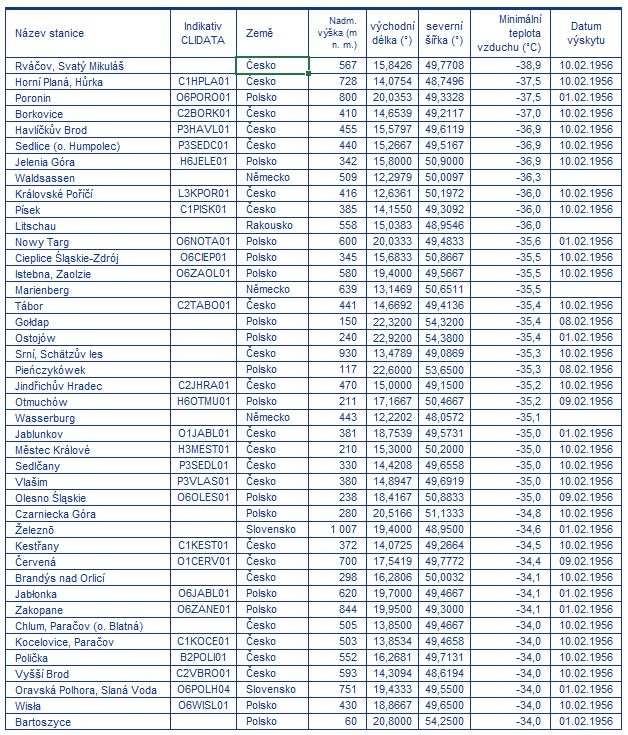
V únoru klesla měsíční minima teploty vzduchu v Česku ještě výrazně níž než v lednu, a to především ráno 10. února. Nejnižší hodnota −38,9 °C byla zaznamenána na stanici Rváčov, Svatý Mikuláš (dříve okres Hlinsko; provoz stanice byl ukončen v roce 1959), i když zdejší minimum může svou odlehlostí vzbuzovat pochybnosti. Dalšími extrémními hodnotami jsou −37,5 °C v Hůrce u Horní Plané (provoz stanice byl ukončen v roce 1963, 5 let po napuštění přehradní nádrže Lipno) a −37,0 °C na dodnes fungující jihočeské stanici Borkovice (obr. 9).

Tuhé mrazy byly zaznamenány na celém území Česka, jak ukazuje nejvyšší měsíční minimum teploty vzduchu –24,0 °C zaznamenané na stanicích Branišovice (199 m n. m.), Děčín, Riegrova ulice (180 m n. m.) a Pohořelice (183 m n. m.). Hodnot nad −25 °C dosáhla měsíční minima i v Praze, Klementinu (191 m n. m.) a na osmi dalších stanicích, nejčastěji na jižní Moravě. Mnoho meteorologických stanic má absolutní minimum teploty vzduchu právě z února 1956, a některé z nich dokonce i v tom případě, že měřily již ve výjimečně mrazivém únoru 1929.
Průměrné měsíční minimum února 1956 v Česku bylo −29,5 °C. Ve výškovém pásmu 100–200 m n. m. dosahovalo −27,6 °C, v pásmu 201–300 m −28,4 °C, v pásmu 301–400 m −30,0 °C, v pásmu 401–700 m −30,5 °C, v pásmu 701–800 m −30,3 °C.
I v širším středoevropském prostoru zůstávají absolutními teplotními minimy v únoru 1956 hodnoty z Česka spolu s hodnotou −37,5 °C dosaženou již 1. února na polské stanici Poronin (tab. 1). Většina měsíčních minim −35,0 °C a nižších byla přitom zaznamenána na stanicích do 600 m n. m., jen čtyři hodnoty se do přehledu dostaly z lokalit nad touto hranicí, nejvýše 930 m n. m. na stanici Srní, Schätzův les. Dokonce ani na alpských vysokohorských stanicích jako je Sonnblick (3 109 m n. m.) nebo německá Zugspitze (2 956 m n. m.) se takto nízká měsíční minima nevyskytla (obr. 10), což ukazuje na výrazný vliv teplotních inverzí především 10. února ráno. Relativně nejslabší mrazy pak zasáhly severozápad Německa, kam studený vzduch od severovýchodu pronikal jen okrajově.
Tab. 1 Měsíční minima denní minimální teploty vzduchu (°C) −34,0 °C a nižší v únoru 1956 na území Česka a okolních zemí.

6. Měsíční průměry teploty vzduchu
Z hlediska měsíčních průměrů teploty vzduchu se v únoru 1956 na rozdíl od teplotních minim již částečně uplatnil vertikální teplotní gradient, takže nejchladněji bylo v Česku v pohraničních horách (obr. 11). Nejnižší průměrná měsíční teplota vzduchu byla zaznamenána na vrcholu Pradědu (−15,3 °C), který byl dokonce o 0,1 °C chladnější než vrchol Sněžky. Nicméně mezi stanicemi s průměrnou únorovou teplotou vzduchu −13,0 °C a nižší najdeme sedm stanic s nadmořskou výškou do 600 m n. m. (tab. 2). Nejméně chladný byl únor 1956 na jižní Moravě, konkrétně na stanici Brno, technika s průměrnou měsíční teplotou vzduchu −9,0 °C, následované stanicemi Dolní Studénky, Třemešek, Klobouky u Brna a Velké Pavlovice (−9,1 °C), Mikulov a Brno, Pisárky (−9,2 °C), Brno, Veveří a Brno, Pisárky, Květná (−9,3 °C), Praha, Klementinum (−9,4 °C) a Podivín (−9,5 °C).

Tab. 2 Průměrná měsíční teplota vzduchu −13,0 °C a nižší v únoru 1956 v Česku.

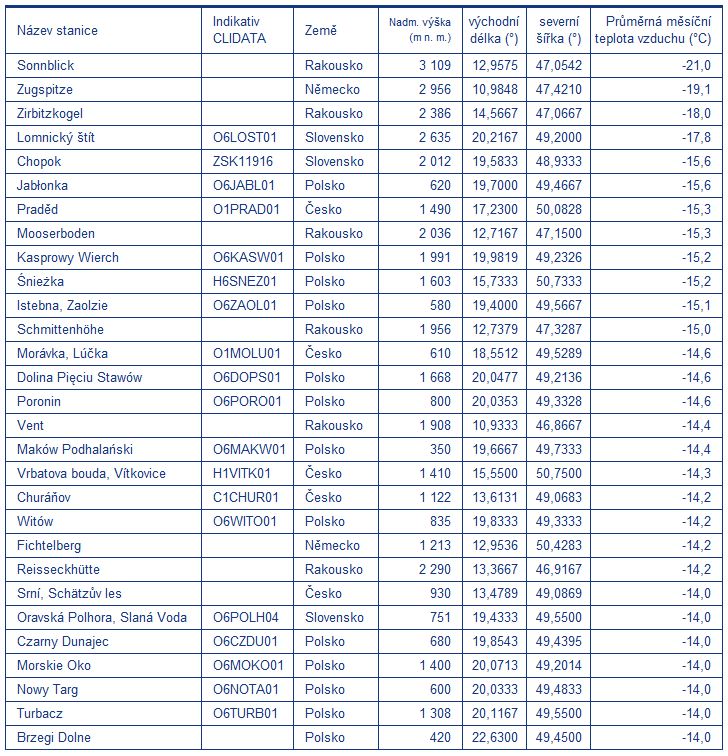
Také v širším prostoru střední Evropy se uplatnila závislost průměrné teploty vzduchu na nadmořské výšce. Nejchladnější stanicí tak byl rakouský Sonnblick (3 109 m n. m.) s měsíčním průměrem −21,0 °C, dále následuje hodnota −19,1 °C z německé stanice Zugspitze v nadmořské výšce 2 956 m n. m., na vrcholu Lomnického štítu (2 635 m n. m.) byl únorový průměr −17,8 °C (tab. 3).
Stejně jako v případě měsíčních minim, i měsíční průměry teploty vzduchu byly v rámci okolních zemí nejvyšší v oblasti přímořských nížin a ostrovů na úplném severu Německa. Nejvyšší průměrná měsíční teplota vzduchu zde byla zaznamenána na stanicích Helgoland (4 m n. m., −3,7 °C), Wangerooge (2 m n. m., −4,7 °C), Borkum-Süderstraße (12 m n. m., −4,8 °C), Langeoog (5 m n. m., −4,9 °C) a Arkona (42 m n. m., −5,0 °C).
Tab. 3 Průměrná měsíční teplota vzduchu −14,0 °C a nižší v únoru 1956 ve střední Evropě.
Porovnání s normálem
Počasí z období před rokem 1961 je obtížné porovnat s jakýmkoliv klimatickým normálem. Nabízí se možnost využití dat z publikace Podnebí Československé socialistické republiky, kterou vydal Hydrometeorologický ústav v roce 1961 s daty za období let 1901–1950 (HMÚ 1961). Nevýhodou tohoto zpracování je z dnešního pohledu nestandardní padesátileté normálové období a absence plošného průměru pro území Česka.
Další možností je využití publikace Průměrné teploty vzduchu v ČSSR (HMÚ 1964a) za období let 1931–1960, kde jsou uvedeny dlouhodobé měsíční a roční průměry teploty vzduchu pro 181 stanic z Česka a 98 stanic ze Slovenska. Samozřejmě je metodicky nepřesné hodnotit období vůči normálu, který obsahuje hodnocené roky, na druhou stranu existoval předpoklad velkého průniku datových souborů. Pro plošné hodnocení teplotních poměrů území Česka v roce 1956 se pak nabízí nejbližší použitelný a dostupný územní normál za období let 1961–1990 (ČHMÚ 2026). Pokud bychom hodnotili data roku 1956 podle normálu 1991–2020, tak by hodnoty rozdílu nabývali větší „extremity“, což nebylo určitě záměrem příspěvku. Normál 1931–1960 není pro nízký počet dostupných stanic zpracovaný plošně na celé území, jen pro jednotlivé stanice.
Plošný průměr teploty vzduchu v Česku byl v únoru 1956 −11,6 °C. Při porovnání s únorovým teplotním normálem 1961–1990 (−1,1 °C), byl únor 1956 na území Česka chladnější o 10,5 °C. Na úrovni dnešních krajů byla největší odchylka od normálu zaznamenána v Praze a Středočeském kraji, a to −11,2 °C. Odchylka Zlínského kraje byla −11,0 °C a odchylky Jihočeského a Ústeckého kraje činily shodně −10,6 °C. Nejmenší odchylku od normálu, a to −9,8 °C, měl Jihomoravský kraj následovaný krajem Olomouckým (−9,9 °C).
Z hlediska jednotlivých stanic, měla v období 1931–1960 nejvyšší únorový normál stanice Praha, Klementinum (0,3 °C), následovaná stanicemi Praha, Karlov (−0,1 °C) a Hodonín, vodárna (−0,4 °C). Naopak nejnižší hodnoty únorového normálu jsou uváděny pro stanice na Pradědu (−7,3 °C), na Lysé hoře (−6,3 °C) a v Bedřichově (−4,6 °C).
V únoru 1956 činila průměrná odchylka od normálu pro území Česka −9,5 °C. Nejmenší odchylka od normálu byla zaznamenána na stanici Benecko, a to −7,0 °C, z dalších stanic měly nejmenší odchylky Vysoké nad Jizerou (−7,5 °C), Lysá hora (−7,6 °C), Bystřice pod Pernštejnem (−7,9 °C), Špindlerův Mlýn, přehrada a Praděd (shodně −8,0 °C), tedy vesměs stanice ve vyšší nadmořské výšce. Ve vnitrozemí Čech bylo sice o několik stupňů méně chladno než na horách, avšak odchylky od únorového normálu zde byly výraznější. Mimořádnost chladného února tak podtrhují stanice s nejvýraznější odchylkou od normálu, kterými byly Poděbrady s odchylkou průměrné měsíční teploty vzduchu −11,6 °C, Sedlčany (−11,4 °C), Lešenice a Čáslav, Nové Město (shodně −11,2 °C) a Mladá Boleslav (−11,0 °C).
7. Poznámky k datům, jejich získávání a digitalizaci
V současnosti existují tři základní způsoby, jak získat zahraniční meteorologická data a integrovat je do klimatologické databáze ČHMÚ CLIDATA. Nejefektivnější formou je přímá výměna dat v definovaném pásmu na základě bilaterálních dohod mezi meteorologickými službami. Taková spolupráce byla navázána se slovenskou stranou před více než 15 lety, kdy došlo k výměně denních dat od 1. ledna 1961 v hraničním pásmu přibližně 50 km od hranice. Poté byla zavedena pravidelná výměna dat prostřednictvím FTP protokolu. Ta probíhá bez komplikací a zahrnuje operativní i kontrolovaná data v různých časových intervalech (10min, 1hod, termínová a denní data). Bylo by prospěšné revidovat seznamy stanic, které jsou v současnosti fixní.
V posledních 15 letech rovněž probíhá výměna dat také s polskou meteorologickou službou IMGW. Operativní data jsou přenášena prostřednictvím FTP protokolu, zkontrolovaná termínová a denní data jsou předávána dávkově. Pro potřeby této studie byla část dat poskytnuta polskou stranou, zbývající údaje byly získány z meteorologických ročenek.
Z území Německa a Rakouska byla využita otevřená data národních meteorologických služeb. Jak z Rakouska, tak z Německa jsou v okolí Česka dostupné časové řady mnoha stanic s různým typem dat i délkou měření.
Specifická byla příprava dat z území Česka. Přibližně 70 % dat bylo získáno z klimatologické aplikace ČHMÚ CLIDATA. Zbytek dat byl získán opisem z meteorologických ročenek. Standardně jsou data z území Česka uložena a zkontrolována (alespoň logickou kontrolou s vazbou mezi meteorologickými prvky) od roku 1961 do dneška. Data z období 1951–1960 se v posledních pěti letech z velké části digitalizovala a stále probíhá jejich kontrola. Údaje z období před rokem 1951 jsou v různé fázi digitalizace a zkontrolován je pravděpodobně jen jejich zlomek. Digitalizace historických meteorologických dat a jejich následná kontrola představují finančně a kapacitně náročný proces. Extrémní hodnoty minimální teploty vzduchu, které byly nalezeny v ročence a nejsou dostupné v klimatologické aplikaci CLIDATA byly porovnávány s okolními stanicemi a s hodnotami extrému průměrné denní teploty vzduchu abychom vyloučili chybu „překlepu“ v ročence.
V roce 2026 pracujeme s modelovými výpočty dat do roku 2100, tedy téměř 75 let dopředu. Srovnatelné množství dat, tj. stejné období (přibližně od roku 1951) máme k dispozici do historie. Starší přístrojová měření z období 1850–1950 však zůstávají pouze částečně digitalizována. Tato skutečnost představuje určitý dluh naší meteorologické služby a je omezením pro detailní studium dlouhodobé variability klimatu a komplexní hodnocení současných změn klimatu.
8. Závěr
Mrazivý únor roku 1956 nebyl z hlediska teploty vzduchu dosud v Česku komplexně zpracován. Z tohoto důvodu jsme prostudovali dostupné materiály a provedli vyhodnocení měsíčních průměrů i denních minim teploty vzduchu a průběhu celé chladné epizody, která začala již koncem ledna 1956. Zpracování bylo rozšířeno také na okolní země (Slovensko, Polsko, Německo a Rakousko).
Průměrná měsíční teplota vzduchu v Česku v únoru 1956 byla −11,6 °C, zatímco únorový normál za období let 1961–1990 byl −1,1 °C. Odchylka února 1956 od normálu tak činí mimořádných −10,5 °C. Doposud nechladnějším měsícem u nás zůstává únor roku 1929 s průměrnou teplotou vzduchu −12,2 °C, třetím nechladnějším měsícem je pak leden roku 1942 s průměrnou měsíční teplotou vzduchu −11,2 °C.
V rámci námi studovaných zemí byl v únoru 1956 nejchladnější měřenou lokalitou rakouský Sonnblick s průměrnou měsíční teplotou vzduchu −21,0 °C, dále německá stanice Zugspitze (−19,1 °C), následoval rakouský Zirbitzkogel (−18,0 °C) a Lomnický štít (−17,8 °C), tedy nejvýše položené stanice. Vliv nadmořské výšky se uplatnil i v Česku, kde byla nejnižší průměrná měsíční teplota vzduchu v únoru 1956 zaznamenána na Pradědu (−15,3 °C), na Sněžce (−15,2 °C) a v Morávce, Lúčce (−14,6 °C). V nižších polohách Čech sice bylo o několik stupňů méně chladno, avšak byly zde zaznamenány o něco větší odchylky měsíčních průměrů od normálu než na horách.
Závislost na nadmořské výšce neplatila v případě měsíčních minim teploty vzduchu, která byla v Česku obzvlášť nízká. Z dostupných dat byly v únoru 1956 tři ze čtyř nejnižších hodnot v rámci sledovaných zemí dosaženy v Česku: −38,9 °C na stanici Rváčov, Svatý Mikuláš, −37,5 °C v Hůrce u Horní Plané a −37,0 °C v Borkovicích. Všechna zmíněná minima byla zaznamenána ráno 10. února 1956, a to v souvislosti s výraznou inverzí teploty vzduchu, která se utvořila během noci při vyjasnění a utišení větru po předchozím vpádu mimořádně studené vzduchové hmoty od severovýchodu.
Porovnání únorů 1929 a 1956 lze provést i v širších socioekonomických souvislostech. Starší událost nastala v době tzv. první Československé republiky, a to naštěstí před vypuknutím velké hospodářské krize počátku 30. let 20. století, která by jistě strádání tehdejších lidí znásobila. Námi studovaný případ se odehrál uprostřed 50. let 20. století, tedy v době tuhého komunistického režimu. V souvislosti s extrémními mrazy února 1956 bychom rádi upozornili na strádání tisíců tehdejších politických vězňů, kteří museli v chatrném vybavení bez jakýchkoli úlev vzdorovat nepřízni počasí, jak dokládá mj. monografie Jáchymovské tábory – peklo, ve kterém mrzlo (Bauer, 2019).
V souvislosti se zpracováváním průběhu počasí a teploty vzduchu z února 1956 jsme nashromáždili velké množství materiálu a dat, z nichž pouze část byla zahrnuta do článku. Z toho důvodu byla vytvořena doprovodná webová stránka, kde je celý text příspěvku a kompletní soubory (rozsáhlé tabulky, grafy, mapy) zpřístupněny všem zájemcům. Čtenáři je naleznou na adrese: http://www.cmes.cz/web/unor-1956-v-cesku-a-v-okolnich-zemich/.
Literatura
aktuality.sk, 2019. Foto: Když bylo na Slovensku opravdu chladno. [online]. [cit. 11. 04. 2026]. Dostupné z WWW: https://www.aktuality.sk/clanok/555901/foto-ked-bola-na-slovensku-prava-zima/?.
ANDREWS, J. F., 1956. The weather and circulation of February 1956. Monthly Weather Review, 84, s. 66–74, DOI: 10.1175/1520-0493(1956)084<0066:TWACOF>2.0.CO;2.
BAUER, Z., 2019. Jáchymovské tábory – peklo, ve kterém mrzlo. NZB, Praha, 960 s. ISBN: 978-80-905864-8-2.
CADIOU, C., YIOU, P., 2025. Simulating record-shattering cold winters of the beginning of the 21st century in France. Weather and Climate Dynamics, 6, s. 1–15, DOI: 10.5194/wcd-6-1-2025.
CLIDATA, 2026. CLIDATA – Climate Database Management System [interní databáze]. Praha: ČHMÚ [cit. 1. 3. 2026]. Dostupné z: ČHMÚ.
COQUILLAT, M., 1958. Les grands froids de février 1956. Bulletin mensuel de la Société linnéenne de Lyon, 27, s. 83–87, DOI: 10.3406/linly.1958.7966.
ČHMÚ, 2026. Územní teploty. [online]. Český hydrometeorologický ústav. [cit. 13. 4. 2026]. Dostupné z WWW: https://intranet.chmi.cz/historicka-data/pocasi/uzemni-teploty#.
ČMeS, 2026. Únor 1956 v Česku a v okolních zemích. [online]. Česká meteorologická společnost. [cit. 15. 6. 2026]. Dostupné z WWW: http://www.cmes.cz/web/unor-1956-v-cesku-a-v-okolnich-zemich/.
DAŇHELKA, J., TYDLITÁT, R., DOLÁK, L., MŰLLER, M., LIPINA, P., TOLASZ, R., ELLEDER, L., NĚMEC, L., ZUSKOVÁ, I., ŘEZNÍČKOVÁ, L., HUDEČKOVÁ, M., HÁJKOVÁ, L., HŮNOVÁ, I., ŠTĚPÁNEK, P., 2025. V Klementinu bylo naměřeno… Praha: ČHMÚ. 1. vyd. 272 s. ISBN 978-80-7653-076-8.
D’ERRICO, M., PONS, F., YIOU, P., TAO, S., NARDINI, C., LUNKEIT, F., FARANDA, D., 2022. Present and future synoptic circulation patterns associated with cold and snowy spells over Italy. Earth System Dynamics, 13, s. 961–992, DOI: 10.5194/esd-13-961-2022.
Deutscher Wetterdienst, 2026. Februar 1956 – Ein Leben wie im Eisschrank. [online]. [cit. 15. 04. 2026]. Dostupné z WWW: https://www.dwd.de/DE/wetter/thema_des_tages/2026/1/25.html#:~:text=Im%20Februar%201956%20suchte%20eine,unter%20dem%20von%201991%2D2020.
DIZERENS, C., LENGGENHAGER, S., SCHWANDER, M., BUCK, A., FOFFA, S., 2017. The 1956 Cold Wave in Western Europe. In: BRÖNNIMANN, S. (Ed.): Historical Weather Extremes in Reanalyses. Geographica Bernensia, G92, S. 101-111, DOI: 0.4480/GB2017.G92.09.
HANSELMAYER, J., WINTER, H., 1957. Der extrem kalte Februar 1956 in Österreich. Zoologisch-Botanische Datenbank, 87, s. 69–73.
HMÚ, 1961. Podnebí Československé socialistické republiky – Tabulky. Vydal HMÚ, Praha. 1. vyd. 379 s.
HMÚ, 1964. Ročenka povětrnostních pozorování meteorologických stanic republiky Československé 1956, HMÚ: Praha. 1. vyd. 295 s.
HMÚ 1964a. Průměrné teploty vzduchu v ČSSR. Vydal HMÚ Praha pro interní potřebu. 10 s.
HRBEK, J., KRHOUNEK, S., 1957. Promrzání půd v zimě 1955–1956. Meteorologické zprávy č. 1, roč. 10, s. 16–23.
IMGW, 1960. Rocznik Meteorologiczny 1956. Wydawnictwa Komunikacji i Łączności Warszawa. 1. vyd., 482 s.
ItalyHeritage, 2025. The snowfall of winter 1956. [online]. [cit. 15. 04. 2026]. Dostupné z WWW: https://www.italyheritage.com/magazine/history/1956-snow.htm.
LIPINA, P., ŠUSTKOVÁ, V., PROCHÁZKA, J., MÜLLER, M., 2026. Mimořádně chladný únor 1956 v Česku. In: Sborník příspěvků z konference pořádané Českým hydrometeorologickým ústavem, Českou meteorologickou společností a Správou Krkonošského národního parku konané ve dnech 19. – 21. května 2026 na Erlebachově boudě v Krkonoších. Praha: ČHMÚ. 1. vydání, 232 s. ISBN 978-80-7653-087-4. K dispozici také [online]. Dostupné z WWW: http://www.cmes.cz/web/wp-content/uploads/2026/05/Krkonose_2026.pdf. s. 152–155.
MAŇÁK, J., 1957. Možno plánovat abnormální chod teploty v únoru? Meteorologické zprávy č. 3, roč. 10. s. 76–79.
NÁROVCOVÁ, J., NÁROVEC, V., ČERMÁK, M., 2006. Jak velké budou po zimě škody mrazem? Lesnická práce, 85, č. 05/06.
NÚÑEZ, M., ÁNGEL, J., MUDERA ROYO, C., AUPÍ ROYO, V., 2007. La gran ola de frío de Febrero de 1956 en la España Mediterránea. Calendario meteorológico, 2007, s. 267–278.
OPENDATA.DWD, 2025. Otevřená data Německé meteorologické služby [online]. DWD [cit. 28. 11. 2025]. Dostupné z WWW: https://opendata.dwd.de/climate_environment/CDC/observations_germany/climate/.
OPENDATA.GeoSphere, 2025. Otevřená data Rakouské meteorologické služby [online].
GeoSphere Austria. [cit. 10. 3. 2026]. Dostupné z WWW: https://dataset.api.hub.geosphere.at/app/frontend/station/historical/klima-v2-1d.
PestBuda, 2021. A blast saved Budapest from icy floods 65 years ago. [online]. [cit. 15. 04. 2026]. Dostupné z WWW: https://pestbuda.hu/en/cikk/20210324_a_blast_saved_budapest_from_icy_floods_65_years_ago.
RIBES, A., ROBIN, Y., TESSIOT, O., CATTIAUX, J., 2025. Recent Extreme Cold Waves are Likely Not to Happen Again This Century. Bulletin of the American Meteorological Society, 106, s. E1759–E1771, DOI: 10.1175/BAMS-D-24-0013.1.
SLOCOMBE, G., 2021. My Personal Connection to Mediterranean Olive Trees via an Anomalous Event. [online]. LandARCHConcepts. [cit. 11. 04. 2026]. Dostupné z WWW: https://landarchconcepts.wordpress.com/my-personal-connection-to-provencal-and-mediterranean-olive-trees-via-an-anomalous-event/.
STŘÍŽ, M., 2008. Popis metod CLIDATA-GIS [online]. [cit. 20. 08. 2024]. Dostupné z WWW: http://www.infomet.cz/fil/1295510217.pdf.
Tvnoviny.sk, 2026. Zima, jakou Evropa nezažila za posledních 70 let: Dunaj v Bratislavě zamrzl, nahromaděný led byl uvolněn leteckým bombardováním. [online]. [cit. 11. 04. 2026]. Dostupné z WWW:
TWARDOSZ, R., KOSSOWSKA-CEZAK, U., PEŁECH, S., 2016. Extremely Cold Winter Months in Europe (1951-2010). Acta Geophysica, 6, s. 2609–2629, DOI: 10.1515/acgeo-2016-0083.
ŽÁK, M., KARLÍK, T., ČT24, 2026. Mráz ze Sibiře před sedmdesáti lety sevřel Evropu. [online]. [cit. 11. 04. 2026]. Dostupné z WWW: https://ct24.ceskatelevize.cz/clanek/pocasi/mraz-ze-sibire-pred-sedmdesati-lety-sevrel-evropu-370529.
Klíčová slova: teplota vzduchu, Německo, Polsko, Rakousko, Slovensko
Poděkování
Autoři článku děkují pracovníkům oddělení meteorologie a klimatologie poboček Českého hydrometeorologického ústavu za dohledání a poskytnutí informací o historických meteorologických stanicích, které jsme nalezli v ročence z roku 1956 a nemáme o nich žádné informace v klimatologické aplikaci CLIDATA. Děkujeme rovněž všem za různé podněty a zejména recenzentům za doporučení a připomínky, které vedly ke zlepšení úrovně článku. Poděkování patří i Jáchymu Brzezinovi za vytvoření webové stránky s rozšířeným obsahem vytvořených materiálů k tomuto článku. Část meteorologických dat z česko-polského příhraničí byla poskytnuta kolegou z IMGW (Instytut Meteorologii i Gospodarki Wodnej Państwowy Instytut Badawczy) Jakubem Sorokou. M. Müller děkuje za podporu projektu CZ.02.01.01/00/22_008/0004605 Přírodní a antropogenní georizika; svým příspěvkem chce také poděkovat za svědectví svému dědečkovi Janu Janouškovi, který strávil únor 1956 v komunistickém lágru Vojna u Příbrami.
Mrazivý únor 1956 v Česku a ve střední Evropě – článek v časopisu Meteorologické zprávy 2026/3 (zde uveden s laskavým souhlasem redakce) doplněný o vytvořené mapy, medailonky vybraných stanic s extrémy teploty vzduchu a výchozím datovým souborem v interaktivní podobě.
Stránky doplňující článek v Meteorologických zprávách vytvořil kolega Jáchym Brzezina, kterému patří za tento počin velké poděkování autorů příspěvku.
Pro zobrazení map, medailonků stanic a výchozího datového souboru v interaktivní podobě klikněte na příslušné texty níže.
Abstract
The Freezing February of 1956 in the Czech Republic and Central Europe
Pavel Lipina, Veronika Šustková, Jan Procházka, Miloslav Müller, Klára Čížková
February 2026 marked the 70th anniversary of the extremely cold February of 1956. This month is often compared to February 1929, which was the coldest month in the Czech Republic in the last 150 years for which we have the measurement data needed for such an assessment. The daily minimum air temperatures recorded on January 31 and February 1, 9, and 10 (and in Slovakia also on February 16–18) 1956 are often compared to the Czech absolute minimum from February 11, 1929. Based on accounts from eyewitnesses in the Šumava Mountains, there is information suggesting that air temperatures there may have reached as low as around −45 °C in February 1956. For this reason, we initially intended to provide a detailed analysis of the entire winter of 1955/1956. However, upon analyzing the coldest winters, we found that the winter of 1955/1956 as a whole does not rank among the coldest, so we decided against a detailed analysis of the entire winter. We focused primarily on the causes and course of the coldest period, i.e., approximately from January 31 to February 10, 1956, and subsequently on a more detailed assessment of February 1956 as a whole.
Since the Czech Republic is not a very large country and the weather and climate generally do not “respect” national borders, we decided to expand the scope of this episode to cover a somewhat larger area, i.e., including neighboring countries. We included all available data from the Czech Republic, Slovakia, Poland, Germany, and Austria in our analysis. We believe that this study, expanded to cover the region, will provide readers with interesting information not only about air temperature extremes but also about the availability of meteorological data during this period and in this area.
Since we gathered a large amount of interesting data, datasets, graphs, and maps while analyzing this exceptionally cold episode, we decided to make the information not used in this article available to interested parties on a webpage created for this article.
Keywords: air temperature, Germany, Poland, Austria, Slovakia